
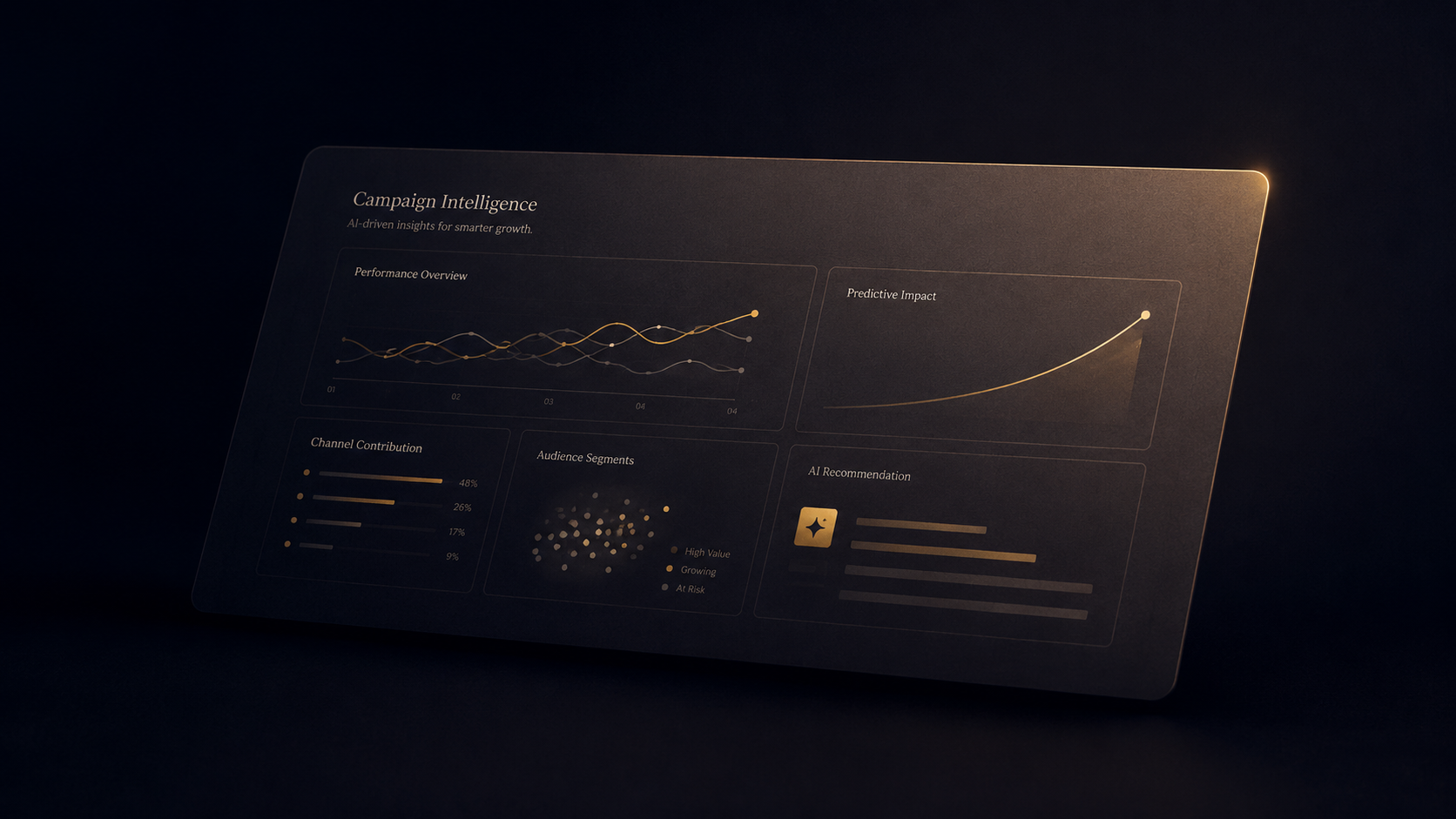
Ecommerce marketing teams have never had more data — but turning it into decisions isn’t always as easy. Every channel produces its own dashboard, every platform has its own definition of "conversion," and every quarter brings pressure to prove that marketing spend is actually working. AI changes what's possible
Key Takeaways
- AI-powered analytics platforms help drive precise, real-time marketing decision-making for ecommerce teams.
- Predictive modeling shifts marketing strategy from historical descriptive reporting to forward-looking, prescriptive customer behavior analysis.
- Successful implementation requires clean data, clear business objectives, and insights that teams can easily take action on.
Why Manual Data Analysis Limits Ecommerce Marketing Performance
Most ecommerce marketers aren't short on data. They're short on a clear, trustworthy view of what that data means, and how to act on it.
Each customer touchpoint typically lives in a different platform — the ad network, the email service provider, the analytics tool, the CRM — and stitching them into one coherent journey is a manual, error-prone exercise that most teams don't have the bandwidth to do consistently.
Budget decisions get made on incomplete information. Without a reliable view of which customers are most valuable and which products and channels drive high LTV acquisition, budget allocation tends to default to "what worked last quarter" or whoever presents the most convincing dashboard. Reallocating spend in response to real-time performance shifts is nearly impossible to do manually at any scale.
Traditional ecommerce analytics tools typically focus on descriptive reporting rather than prescriptive insights or predictive modeling. They can tell you that the conversion rate dropped 8% last week; they generally can't tell you which of the dozen variables that changed was responsible, or what to change to fix it. That gap between reporting and decision-making is where most marketing performance gets left on the table.
How AI-Powered Analytics Platforms Improve Marketing Performance
AI-powered analytics platforms are built to close that gap. AI-driven pattern recognition identifies trends across high-volume datasets that manual analysis cannot replicate. Rather than relying on a marketer to notice that a particular segment behaves differently, AI models can process significant volumes of data simultaneously, surfacing patterns in customer behavior that would otherwise stay buried across disconnected systems.
Instead of only reporting what a customer has already spent, predictive models can estimate future customer lifetime value (LTV) — identifying which new customers are likely to become high-value, repeat buyers long before that behavior shows up in a cohort report. That distinction matters for budget allocation: a channel that produces a low average order value today might be quietly acquiring the customers who will spend the most over the next two years.
The most valuable shift, though, is from insight to action. Rather than stopping at "here's what happened," AI-powered platforms like Decile increasingly offer prescriptive recommendations — like which audiences to prioritize and which products to highlight, which users can then take action on directly from the platform. Each newly acquired customer is instantly mapped to the relevant persona or audience in real time. That turns analytics from a rearview mirror into something closer to a co-pilot for ongoing campaign decisions.
Taken together, this reframes AI not as a faster version of the old dashboard, but as a different kind of tool entirely — one built for continuous optimization rather than periodic review. By understanding how AI analytics optimizes ecommerce marketing campaigns, businesses can finally move past static reporting and embrace dynamic, data-backed growth strategies.
How to Evaluate and Select an AI-Powered Ecommerce Analytics Platform
Choosing among AI-powered analytics platforms comes down to a handful of practical questions. Use this as a checklist when evaluating vendors.
Data integration. What sources can the platform ingest — Shopify or your ecommerce platform, ad networks, email service provider? Predictive models are only as good as the data feeding them, and gaps in integration create blind spots in downstream recommendations.
Data enrichment. Find a tool that not only analyzes first-party data, but enriches that with additional attributes, like demographics, psychographics and behavioral traits. This allows for hyper-personalization at the customer level.
Predictive models. Ask what the platform is actually predicting, like LTV, lifecycle stage, and propensity to purchase.
Usability of the insights. Look for interfaces that translate insights into specific, actionable recommendations. Find tools that integrate with your email provider and ad platforms, so you can build custom segments and push them directly into your campaigns.
Profitable growth. A platform should be able to help provide incremental lift, generating revenue that was not being generated previously.
Implementation Risks in AI-Driven Marketing Analytics
Starting without clear business objectives. Teams that adopt an AI platform because "we should be using AI" rather than to solve a specific problem — reducing customer acquisition cost, improving retention, increasing LTV — end up with a tool that generates insights nobody acts on. Define the business outcome first, then evaluate whether AI helps get there.
A wobbly data foundation. AI models are only as reliable as the data behind them. Duplicate customer records, missing order history, or disconnected data sources will quietly produce recommendations that look precise but rest on a shaky foundation.
Failing to build AI insights into workflows. Producing excellent recommendations that never make it into a campaign brief or a budget meeting doesn’t actually change outcomes. The teams that see the most value are the ones that build AI-driven insights into existing workflows rather than treating the platform as a separate, occasional check-in. With platforms like Decile that integrate conversational AI features, finding and acting on insights are fast and simple - including creating and saving audience segments just by asking.
Avoiding these pitfalls comes down to one underlying principle: AI is a tool for better decisions, not a replacement for having clear goals, clean data, and a team willing to act on what it finds.